5 hours ago
Methodist Pastor Phillippa Phaneuf Comes Out as Transgender During Sunday Service in Rochester, New York
READ TIME: 5 MIN.
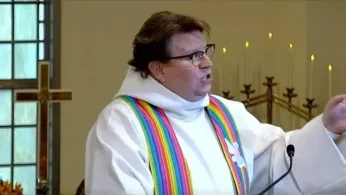
On Sunday, November 23, 2025, Rev. Phillippa Phaneuf stood before her congregation at North Chili United Methodist Church in Rochester, New York, and shared one of the most personal announcements of her life. Wearing a rainbow stole, Phaneuf addressed the gathered worshippers from the pulpit to reveal that she is a transgender woman and has begun the process of living authentically.
"I am affirming to all of you that I am transgender," Phaneuf stated during the service. "The best way to put this is that I'm not becoming a woman, I'm giving up pretending to be a man. This is a process, and it may be shocking for some as to what this all means."
The 51-year-old pastor framed her transition as part of a larger spiritual and personal journey, using a medical analogy to help her congregation understand the significance of the moment. "Imagine if your doctor came and told you that your quality and outlook on life could transform exponentially to the positive. Would you listen to that doctor? If you felt God's Holy Spirit surrounding you in ways that you haven't felt in years, would you have a sense that that might be something that God was okay with?"
Phaneuf emphasized that the hormone replacement therapy she has been receiving for the past three months has brought her genuine happiness. "It has led me to feel truly happy for the first time in a long time, " she shared with her congregation. She also announced that she will change her name to Phillippa and use she/her pronouns moving forward.
What distinguishes Phaneuf's announcement is the explicit support she has received from church leadership and the broader United Methodist Church denomination. Prior to making her public announcement, Phaneuf consulted with her bishop and other senior church officials, all of whom affirmed her decision.
"The bishop, church and theology support the transition," Phaneuf told her congregation, noting that her pastoral duties at the church will not be affected by her transition.
This institutional support reflects significant changes within the United Methodist Church. Last year, the denomination reversed long-standing rules that had condemned LGBTQ+ identities within the community. The UMC now explicitly affirms human sexuality "as a sacred gift" and states that this affirmation "applies to all persons, regardless of sexual orientation or gender identity."
The denomination's official position emphasizes pastoral care and inclusion. "The United Methodist Church commits to befriending and caring for all persons, including LGBTQ persons in our churches and communities," the church stated in its official guidance.
The North Chili United Methodist Church itself reflects this commitment to inclusion. The church's website describes it as a place "where all are genuinely welcome, loved and accepted as God welcomes, loves, and accepts all."
Phaneuf's announcement was met with overwhelming support from her congregation. Following her public disclosure, she told Fox News Digital that "the community has been extremely welcoming." On social media, Phaneuf later thanked friends, fellow clergy, and church leaders for messages of encouragement and support.
Several Methodist clergy from other parts of the United States also posted messages expressing solidarity, describing the announcement as a moment of openness within the life of the church.
During a subsequent Sunday morning worship service on November 30, 2025, Phaneuf wore a stole in the colors of the transgender flag and addressed the congregation again, appearing visibly at ease as she continued her ministry.
Beyond her gender identity, Phaneuf also shared information about her sexual orientation during her announcement. She disclosed that she now identifies as asexual, an orientation in which a person experiences little or no sexual attraction to others. "I'm in the category of what they call asexual," Phaneuf explained. "I've been that way since we've all been together, in that I am not living my life in a way that involves looking for romance."
Throughout her announcement, Phaneuf emphasized that her transition does not change her dedication to her congregation or her role as a spiritual leader. "What will stay the same is my deepening love for all of you," she told her congregation.
Phaneuf also expressed hope that her authenticity could expand the church's mission of inclusion. She shared that she hopes the church could become "known within the community as an even safer space for people who have felt marginalized."
In a moment of transparency, Phaneuf also addressed the complexity of her family situation during her sermon. She disclosed that her parents do not currently support her transition. "They asked me to tell you all that they do not support me," Phaneuf announced to her congregation.
Despite this lack of parental support, Phaneuf chose to be open about the reality with her congregation, asking for understanding regarding her parents'position. This candor reflects Phaneuf's commitment to authentic leadership and vulnerability within her faith community.
Phaneuf's announcement occurs within a significant period of transformation for the United Methodist Church. The denomination has undergone prolonged internal debate over issues of sexuality and gender identity in recent years.
The church has moved toward more inclusive language and policies, including changes to its governing Book of Discipline to remove provisions that had previously limited the participation of LGBTQ+ clergy and members.
These changes have not been without controversy. Over the years, some congregations and clergy have left the denomination over doctrinal disagreements regarding LGBTQ+ inclusion. Supporters of the reforms have argued that they reflect a commitment to equality and pastoral care, while critics maintain that the changes depart from traditional interpretations of scripture.
Phaneuf's announcement places her local church at the center of this wider denominational conversation. While church leadership has publicly supported her decision, the range of reactions within congregations highlights the contrasting views that remain within religious communities across the United States.
Phaneuf's public disclosure represents a significant moment for LGBTQ+ representation within religious leadership in the United States. As a senior minister who came out as transgender while maintaining her pastoral position, Phaneuf demonstrates that gender identity and faith leadership are not mutually exclusive. Her willingness to be vulnerable and authentic with her congregation, coupled with the institutional support she has received, offers a model of how faith communities can evolve to become more inclusive and affirming spaces.
The announcement also underscores the ongoing transformation within mainline Protestant denominations as they grapple with questions of identity, inclusion, and theological interpretation. Phaneuf's journey invites broader reflection on how religious institutions can honor the fullness of human identity while maintaining spiritual commitment and pastoral care.
As Phaneuf continues her ministry at North Chili United Methodist Church, her transition serves as a testament to the possibility of living authentically within faith communities that choose to prioritize love, acceptance, and genuine welcome for all people.