October 21, 2025
SF supervisors move forward set of LGBTQ sites to landmark
Matthew S. Bajko READ TIME: 5 MIN.
One is where a pioneering LGBTQ synagogue first opened in San Francisco. Another was once home to a popular lesbian bar not far from the famous Haight Ashbury intersection.
A third was where one of the country’s first AIDS nonprofits got its start in the heart of the LGBTQ Castro district. Also on the list are the sites where a Catholic parish helped care for its members dying of AIDS in the early days of the epidemic.
They are among the 16 properties expected to become city landmarks next year due to gay District 8 Supervisor Rafael Mandelman requesting city officials begin the process to grant the sites such local recognition. The buildings are all located within his supervisorial district, spanning from Cole Valley and Corona Heights to the Mission and Noe Valley.
The Board of Supervisors voted unanimously 10-0 Tuesday to have the city’s Historic Preservation Commission review the landmark requests. The oversight body will have 90 days to make its decision once sent the proposals.
Mandelman, who is president of the board, has been working for some time to landmark the properties, which would be given some protection from having their facades altered once given such status. Any development of the properties would also require greater scrutiny from city planning officials due to their being landmarked.
As the Bay Area Reporter previously reported this month, Mandelman moved the 16 sites forward now due to concerns they could be targeted for demolition in order to build housing on the parcels under Mayor Daniel Lurie’s family zoning plan now before the supervisors. It was taken up by the supervisors’ land use committee Monday ahead of it being voted on by the full board in the coming weeks.
When the same panel took up his landmarks request October 6, Mandelman reiterated his support for seeing more housing be built across the city in order to address the lack of, and high cost of, apartments and homes in San Francisco. At the same time, such residential development shouldn’t come at the cost of historic structures being replaced, he told the land use committee members.
“It does, I think, also require we give some special thought and attention to the buildings we have and want to preserve, whatever may come in the way of growth,” said Mandelman. “It is incumbent on us to do the work on the front end before those development proposals come forward, and that we identify those buildings we do think require additional protections as landmarks or parts of historic districts.”
As the family zoning comes up for a vote at the board, Mandelman said “the reality is” it will bring added pressure for demolishing historic resources in the parts of the city being upzoned for denser housing. He doesn’t believe such an outcome is required to increase the city’s housing supply.
“I don’t think the deal is to get the units we need, we need to demolish our historic resources. If that is the deal, then I am not down,” said Mandelman. “I think we can do both.”
In response to a question from committee member District 5 Supervisor Bilal Mahmood, senior preservation planner Alex Westhoff said half of the proposed landmark sites in District 8 would be covered by the family zoning plan if it is implemented.
“It wouldn’t change the allowable height for any of these properties,” said Westhoff should they be landmarked. “You could still add height and vertical additions to historic properties.”
He also said the District 8 landmarks are being used as a pilot, with the planning department also eying sites to landmark in other supervisorial districts, such as the Richmond-based District 1; in District 11 that includes the Excelsior and Ingleside neighborhoods; and in District 2 covering older parts of the city such as Cow Hollow, the Marina, and Pacific Heights.
“We are focused on nonresidential or multi-residential buildings, not on single-family homes,” Westhoff noted of the properties that could be landmarked.
The land use committee had voted 3-0 in support of moving Mandelman’s 16 proposed city landmarks forward, which led to the board’s October 21 vote on them. None of the property owners had spoken in opposition at the land use hearing, while chair District 7 Supervisor Myrna Melgar thanked Mandelman “for your timely pursuit on these efforts.”
She agreed with his contention that new housing shouldn’t come at the expense of historic properties.
“I also agree we don’t need to demolish everything to comply with our commitments,” said Melgar, referring to the number of new housing units the state is demanding San Francisco build in the coming years. “I also think there are tools at our disposal we can use to think creatively about these issues.”
The full board voted in support of moving the landmarks forward without comment. It coincided with the fourth week of LGBTQ History Month, observed across the U.S. each October.
Seven directly correspond to the city’s LGBTQ community, such as the former home of the late B.A.R. founder Bob Ross at 4200 20th Street and the inaugural site of the San Francisco AIDS Foundation at 514-20 Castro Street. The historic former site of LGBTQ synagogue Sha’ar Zahav (1983-1998) at 220 Danvers Street and the LGBTQ-friendly Most Holy Redeemer Roman Catholic Church’s buildings at 100-117 Diamond Street are also on the list.
The locations of several pioneering but now defunct LGBTQ businesses would also be recognized. They are the former site (1966-1989) of Maud’s lesbian bar at 929-41 Cole Street; the former site (1971-1977) of the Castro Rock Steam Baths at 582 Castro Street; and the former site (1974-1977) of the Full Moon Coffeehouse at 4416 18th Street.
Also set to become city landmarks are St. Paul’s Church at 1660 Church Street (Roman Catholic), which was the exterior used for the film “Sister Act;” St. Matthew’s Church (Lutheran) at 3281 16th Street; and St. Nicholas Cathedral (Russian Orthodox) at 2005 15th Street. Two locations related to the city’s fire department – Hose Company No. 30, located at 1757 Waller Street and Engine Company No.13, 1458 Valencia Street – are also on the list.
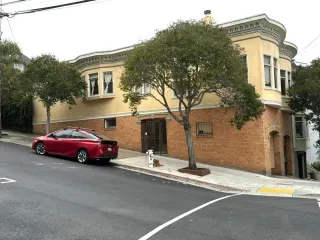
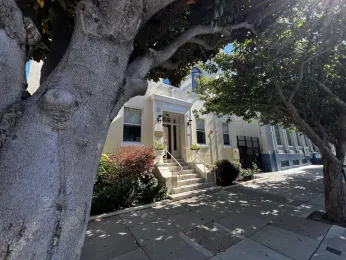
Three residential properties would also become landmarks due to their architectural significance, including 102 Guerrero Street, 361 San Jose Avenue, and the Chautauqua House located at 1451 Masonic Avenue. The latter, built in 1909, was where the American Indian Historical Society had its headquarters from 1967-1986 and would be the first city landmark related to American Indian history.
The last building on the list is the Bank of Italy Branch Building, located at 400-410 Castro Street at the intersection of Market Street. It sits at the entrance to Harvey Milk Plaza and the Castro Muni Station, considered to be the front door into the neighborhood.