August 25, 2025
New book documents SF’s trans history
David-Elijah Nahmod READ TIME: 8 MIN.
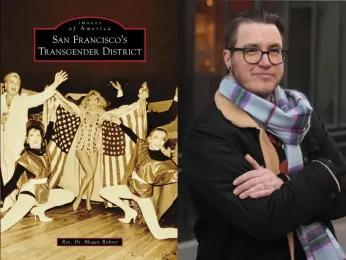
To commemorate Transgender History Month, the Reverend Dr. Megan Rohrer, a transgender man, published a new photo book this month about the history of the trans community in San Francisco. In "Images of America: San Francisco's Transgender District," Rohrer offers hundreds of archival photos, dating back to the 19th century, as well as more recent images.
The book's cover may bring a tear to anyone who was in the city 40 years ago. It features a black and white photo of "Naked Brunch," a drag show that was performed in the city in the mid-1980s. The cast of "Naked Brunch" is seen in all their gender-bending glory, including the late Doris Fish (the drag persona of Philip Clargo Mills) and the late Tippi (Brian Douglas Mead), roommates and performing partners who were among the biggest drag stars of that era.
In his introduction, Rohrer pays homage to the first legally recognized Transgender District, located across six blocks in the Tenderloin and a sliver of Sixth Street South of Market, which in decades past was a hub for the trans community and remains so. Rohrer defines transgender as “the many ways that gender-diverse people identify, embody, and organize. From drag to bodily and hormonal changes, there is a wide spectrum of trans embodiment and expression.”
In an interview with the Bay Area Reporter, Rohrer said that he was inspired to put the book together by conversations he had with Jupiter Peraza, a trans leader who led the efforts to get August recognized as Transgender History Month both in San Francisco, which started in 2021, and California, which is officially being recognized for the first time this year.
"We wanted trans and gender-nonconforming people of all ages to have access to the inspirational artistry, activism, and embodied beauty of our elders and ancestors who have lived in San Francisco for more than two centuries," Rohrer said.
In an email, Peraza noted that the book is needed.
“Dr. Rohrer’s book is incredibly important – not only because it memorializes transgender history during a time in which the federal administration is violently erasing the existence of trans people from public record – but because it provides a lifeline for transgender people across the country who have no access to community networks, transgender cultural enrichment, and collective future ideation,” she stated. “Dr. Rohrer has produced a piece of work that is timeless, visually powerful, and culturally significant. It is truly exemplary of trans people crafting our own historical narrative for perpetuity.”
Peraza also stated that the Transgender District is “an essential component to San Francisco’s cultural and historical footprint and spiritual essence.”
“Transgender and gender-expansive individuals have undoubtedly played a critical role in fashioning San Francisco into a world-class city,” she explained. “The Transgender District is also a resounding symbol of belonging – directly serving as the antithesis to the White House’s claims that trans people do not belong in society. The reality is: trans people are cultural bearers whose spirit and essence have cultivated innovative cultural practices and vibrant placemaking.”
As the B.A.R. has reported, Rohrer has been making history for quite a while. Rohrer is the first openly transgender minister to be ordained in the Lutheran tradition. He served as bishop of the Sierra Pacific Synod of the Evangelical Lutheran Church in America, having been elected in 2021. He resigned in June 2022, at the request of Elizabeth Eaton, presiding bishop of the ELCA. Rohrer, as bishop, had fired a popular Latino minister, the Reverend Nelson Rabell-Gonzalez, pastor of Misión Latina Luterana in Stockton. The firing took place on December 12, 2021, which was the Feast of Our Lady of Guadalupe, a sacred day for the congregation's largely Latine congregants. The congregation was enraged and allegations of racism followed, as well as a petition to remove Rohrer as bishop.
Rohrer tells the B.A.R. a different story.
"In the days after my election, the Synod office was flooded with so many harassing and inappropriate calls and letters that we had to switch to an automated answering service that recorded messages," Rohrer said. "The San Francisco Police Department helped me purchase a bulletproof vest, which I wore from time to time based on the recommendations of safety advisers. My family made efforts to increase the security at our home and at my kids' elementary school. Being a historic first in a community is an honor, but it is also a lot to carry."
Prior to becoming bishop, Rohrer had served as community chaplain coordinator to the SFPD.
According to Rohrer, the pressure to leave his post was enormous. Rohrer claims that the national bishop spread disinformation about him through news releases while telling a local gathering via livestream that Rohrer had followed the rules of the church. Despite this, the former bishop claimed, attendees of the gathering continued to spread disinformation about him, misgendering him 44 times.
A year after resigning, Rohrer filed a lawsuit against the Sierra Pacific Synod, alleging harassment and breach of contract, among other charges. That suit has been settled.
"My lawsuit, which outlined the near daily hate mail and death threats I received for following the direction of church superiors, was resolved in a way that satisfied my claims," he said, declining to offer specifics. "My personal journey healing from the trauma and spiritual betrayals have been a much longer journey of wellness and recovery. Researching centuries of trans San Franciscans who acted up, turned tragedy into art and paved the way for future generations has given me strength for my own journey forward. I hope it will also inspire others to navigate the slings and arrows they encounter."
The Sierra Pacific Synod of the ELCA did not respond to the B.A.R.'s email and voicemail messages requesting comment.
Today, Rohrer is part of the Chaplaincy Institute, an interfaith community that credentials faith leaders and provides justice-centered education for interfaith leaders, professional chaplains, and spiritual directors. He teaches a few courses for its seminary, including a course in chaplaincy to the transgender community, as well as courses about caring for people at protests, vigils, and other public gatherings. Rohrer is also actively involved in preserving trans history, leading tours in the Transgender District in San Francisco.
The book
"Images of America: San Francisco’s Transgender District" features dozens of archival photographs of trans and gender-nonconforming people who performed in drag in San Francisco during the 19th and early 20th centuries. There's an extensive section devoted to Finocchio's, the popular North Beach club that for decades featured drag performances, then known as female impersonators. The book also includes more recent photos, such as San Francisco Trans Marches. Throughout the book each photo is captioned with identifying and historical information about the photo's subject.
"I spoke with community leaders, local photographers, traveled to libraries and archives around the country, purchased photos and ephemera from other collectors, and recreated a few photos to ensure that BIPOC leaders are also represented in the book," Rohrer said, referring to Black, Indigenous, and people of color. "I combed the archives of the San Francisco Chronicle, from the 1800s through the 1970s, the time period centered in the ‘Images of America’ series. It was much more work than I imagined when I first began the book. To make these photos easier for future researchers to find, all the historic photos I acquired for this book will be donated to the GLBT Historical Society after the promotional events conclude."
Compton’s riot
Perhaps the most famous site in the Tenderloin is the former Gene Compton’s Cafeteria at 111 Taylor Street. Now a reentry facility for formerly incarcerated individuals run by GEO Group Inc., the property earlier this year became the first one of its kind granted federal landmark status specifically for its connection to the transgender movement in the U.S. It is also now on the California Register of Historical Resources.
In 2022, the San Francisco Board of Supervisors declared the intersection in front of Compton’s and the exterior walls of 111 Taylor Street as the city’s 307th landmark . It provides some level of protection to the building facade from being altered.
But one night in August 1966, Compton’s was the site of civil unrest. A drag queen reportedly threw a cup of hot coffee in the face of a police officer who tried to arrest her without a warrant. The incident sparked a riot between trans and queer patrons of the 24-hour diner and cops, as detailed in the 2005 documentary "Screaming Queens" by transgender scholar and historian Susan Stryker, Ph.D. .
Activists this year have worked to reclaim the Compton’s site, so far unsuccessfully, as the B.A.R. has reported.
The Compton's photos in Rohrer’s book were provided by the GLBT Historical Society and the Tenderloin Museum. They show several gender-bending individuals sitting at a table inside Compton's, but are not from the night of the riot. In Stryker’s film, she talks to several trans women who used to hang out at Compton’s.
Rohrer told the B.A.R. that he could not find a date for the riot, which has been lost to time. Stryker has also been unable to find a date.
“Vanguard began protesting Compton's security on July 19 – the trans women are said to have rioted sometime in August – but no exact date is known,” Rohrer stated. “I went through the police records at the library for that full year surrounding it – it is not listed in the police report. I think the only mention of it is from the Reverend Ray Broshears in his Gay Crusader paper.”
Vanguard was an early LGBTQ organization that worked in the Tenderloin.
Other photos
Roher also spoke of the process by which he chose which photos to include in the book.
"Transmisia, a biased belief that trans people are always lying about their experiences, actions, and motivations in order to trick or harm others, was becoming increasingly rabid when I first began writing the book," he said. "Sadly, it continues to grow and is intentionally propagated in the highest political offices. I curated photos that counter political lies, claiming that trans people are a new phenomenon. I also amplified antique and vintage photography that sheds light on contemporary issues and, in some cases, suggests creative and rebellious responses that can be used to fight back against unjust policies, laws, and attitudes."
It took Rohrer about a year to put the book together. This included pitching the book to Arcadia Publishing, assembling the photos, getting rights to photos, and completing several drafts.
"Since many of the photos in this book are a highlight reel from my two decades of work and activism with the homeless and LGBTQ community in San Francisco, I suppose the community work, relationship building, and photography took much longer," he said. "The book has photos from my personal collection and my work with homeless LGBTQ youth, the San Francisco Police Department, Glide Memorial Church, [and] at protests and marches."
Rohrer hopes that the book will reach a wide readership.
"I hope gender-nonconforming people will see the book cover in grocery stores and airports and remember that they are part of a diverse community of fabulously brave people," he said. "I hope grandmas will buy the book as a trinket on their vacation to San Francisco and share it with their grandkids as a way to tell them they love them. I hope those who are disturbed by the laws that are targeting trans people will use it as a roadmap to ACT UP and fight back. I hope those stoking division inside the LGBTQ community will see that diverse communities can be a part of the same book and put as much effort into creating change as they do into disliking others.
“I hope the photos from the 1800s will open the minds and hearts of all who have been lied to, when they were told that being trans is a new thing,” Rohrer added. “I hope those who have been pushed out, bullied or harassed will be inspired by the mentors, elders and ancestors in the book. Most of all, I hope the book will inspire more trans people to share their stories, photos and histories."
"Images of America: San Francisco's Transgender District" is now available from Arcadia Publishing. Copies can be purchased directly from the publisher or at Fabulosa Books, 489 Castro Street.
Full disclosure: The Bay Area Reporter contributed a few photos for the book and is thanked in the book's acknowledgements.
Updated, 8/25/25: This article has been updated with comments from Jupiter Peraza.